Exploring the spiritual, cultural, and political factors that draw young Moroccans towards Sufism.
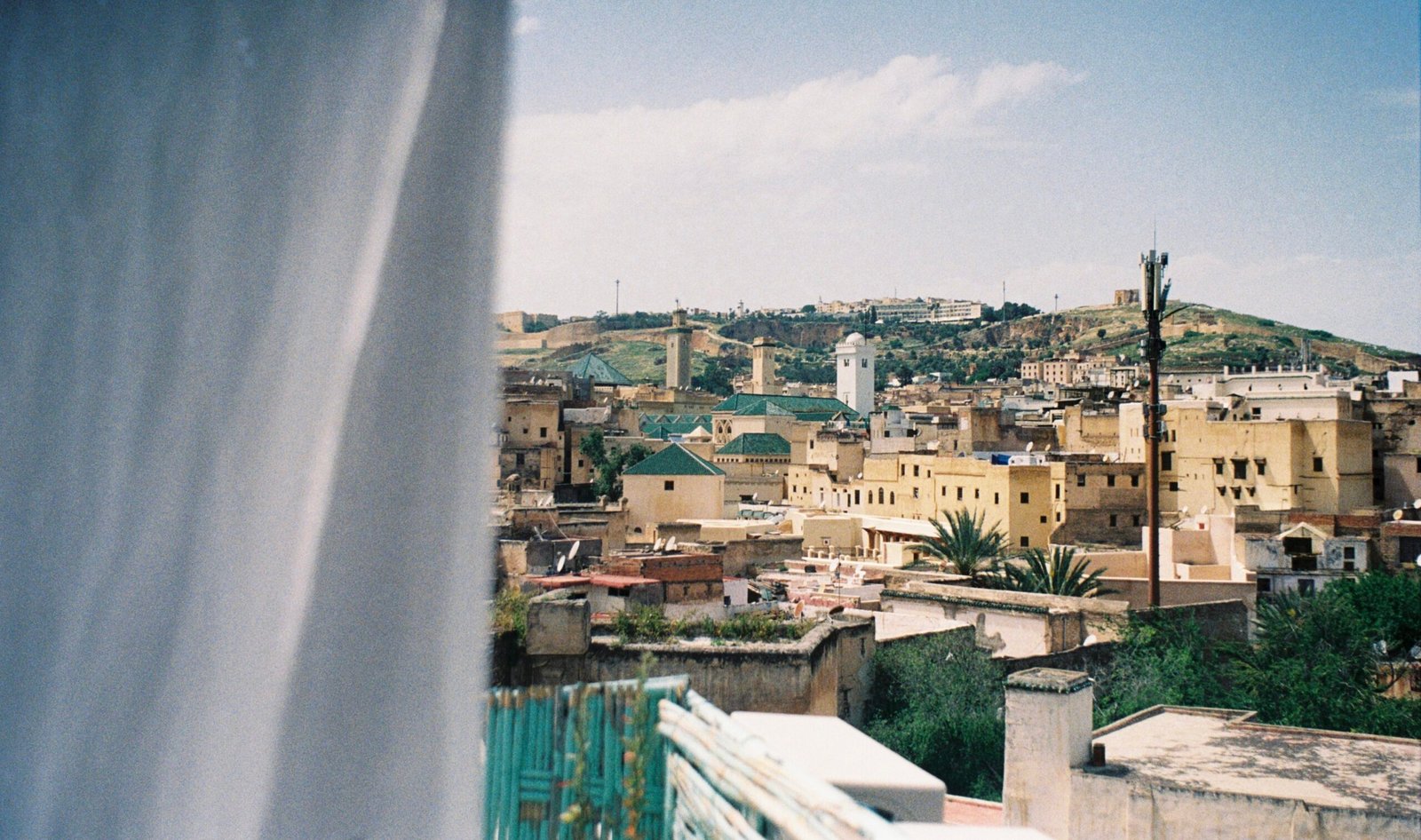
Fez. The spiritual capital of Morocco.
Recitations of the Qur’an echo off the medina walls, whilst locals dressed in djellabas meander through its narrow streets. Sometimes referred to as Medinat al-Awliya (City of Saints), the medina is home to a high number of shrines for revered Sufi figures who are buried here.
Fez, and Morocco more widely, has a long tradition of Sufism.
Rather than a distinct branch of Islam like Sunni or Shia, Sufism is a spiritual tradition associated with mysticism that focuses on the pursuit of a personal connection with God. Central practices such as dhikr (remembrance of God) involve the repeated recitation of Allah’s 99 names and other devotional phrases as a way of reaching closeness to the divine.
Sufism has been present in Morocco for over a millennium and has played a significant role in shaping the country’s religious and cultural identity, as well as its politics.
However, in the decades following Morocco’s independence in 1956, its influence began to experience decline as reformist interpretations of Islam, such as Salafism, increased in popularity. Additionally, Muslim Brotherhood-inspired Islamist movements also gained support among students in the 1970s, with the most notable example being Shabiba al-Islamiya (Islamic Youth).
Yet, a 2020 article titled “Sufism in Modern Morocco” states that a “Sufi revival” may now be happening in the country. Curious about how this possible revival is being experienced by younger generations, I travelled to Fez. I wanted to better understand what is drawing young Moroccans towards Sufism today, and the role that it plays in their lives.
“It’s in My Heart; It’s in My Blood”
Abdul, 29, is a taxi driver in Fez. “[Sufism] is in my heart; it’s in my blood” he tells me, as we sit down for a coffee near Bab Boujloud, Fez’s iconic blue gate.
“When I say ‘Sufi’, my hairs stand up… I feel it now.”
Within Sufism, different brotherhoods exist, each with their own distinct traditions and lineages. Abdul is part of the Issawa Brotherhood, which is well-known for rituals in which chanting is accompanied by percussion and the ghaita (a double-reed wind instrument).
He tells me that he often hosts Sufi gatherings at his home, sometimes with over 1000 guests, and shows me a video of one of these gatherings. In it, he plays an instrument, whilst people around him link arms as they dance and sing.
“We sing about Allah, about Prophet Muhammad, about Moulay Idriss*” he explains. “We sing about love, about life.”
In another video, a man cries whilst he plays percussion to accompany a chant. This is because “he feels it so much,” Abdul says.
Is State Promotion Changing Sufism?
Abdul comes from an Issawa family so was exposed to Sufi practices from a young age. His young children will also grow up in a household where Sufi chanting and rituals are a constant presence. Yet not all Moroccans who identify as Sufi are born into this environment.
Some of the people that attend Abdul’s gatherings identify as Sufi, despite coming from families who do not. I ask how these people usually become interested in Sufism and he explains that it is often through festivals, such as the Fez Festival of Sufi Culture.
Dr Nina ter Laan is a Dutch cultural anthropologist and researcher at the University of Cologne, whose doctoral research examines the intersections of Islam-inspired music and politics in Morocco. She notes that whilst these Sufi festivals do not “explicitly” target young people, they do attract them.
Dr ter Laan explains that in the wake of 9/11 and the Casablanca 2003 bombings — where 12 suicide bombers from the Salafia Jihadia militant group took the lives of 33 civilians — the Moroccan government began to promote Sufism as a key marker of a “tolerant” and “Moroccan” form of Islam, positioning it as a counter to extremism. One of the ways that they have done this, she describes, has been through state support for international music festivals.
These festivals, however, are not necessarily accessible to everyone, Dr ter Laan adds. They can be relatively expensive and are geared largely towards Western tourists, meaning that the Moroccans who are able to attend often come from relatively privileged socioeconomic backgrounds. Therefore, their impact in increasing the visibility of Sufism domestically is likely to be greater amongst wealthier Moroccans.
Although state promotion began more than 20 years ago, these festivals still continue to attract large audiences from both Morocco and abroad. But how does the Sufism encountered by young Moroccans at these festivals relate to the devotional traditions practised in zawiyas (Sufi lodges)? Are younger generations now engaging with Sufism primarily as a form of cultural heritage, rather than as a theological tradition?
“There is definitely heritagisation,” says Dr ter Laan, adding that the often lengthy and repetitive rituals practised by different Sufi brotherhoods in zawiyas are shortened, choreographed and standardised for festival stages. Some brotherhoods also withhold the most sacred or intimate elements of their traditional rituals, meaning that what is presented at these festivals is a much more “manicured” version of Sufi practice. At the same time, Dr ter Laan cautions against drawing too sharp a distinction between religion and heritage, arguing that the two are “intertwined.”
This idea is echoed by Mohammad Hamdonui, a ritual anthropologist, who tells me that the spiritual and cultural aspects of Sufism “co-constitute each other through a kind of dialectical movement.” He adds that “Sufism has never been monolithic,” but accommodates “different traditions” and “degrees of engagement.”
Back in the cafe with Abdul, I also get a sense of the plurality of Sufism. He repeats “Sufi is sea” on several occasions throughout our conversation, which reflects the diversity of thought and practice within the tradition.
My overarching impression is that Abdul’s attachment to Sufism is rooted in a deep, powerful “feeling” that cannot easily be explained in words. “When I’m full of problems in life and work, I go to Sufi festivals and it’s like I’m born a new guy” he tells me. “I cry and all the bad things, all the bad energy, goes away… it makes me feel better.”
I then ask him about the religious side of his practice. He talks about his book of dhikr, which he reads in his free time. For him, this is not only a source of comfort, but also a way of strengthening his connection with Allah.
“I really feel close to God through Suf[ism],” he tells me.
Sufism in the Diaspora
I find myself curious as to whether the Moroccan state’s promotion of Sufism has also influenced diaspora communities outside of the country.
“There is very strong outreach politics of Morocco to the diaspora” explains Dr ter Laan. This involves promotion of a “Moroccan Islam” based upon three key components: Sufism, Malikism, and Ash‘ari theology.
This outreach has also been used to address concerns that extremist ideologies could spread from Europe to Morocco, she adds. And more broadly, it reflects an effort by the state to encourage forms of religious practice that are “congruent” with its own interpretation of Islam.
Via Reddit, I get in touch with a 21-year-old woman from Amsterdam’s Moroccan diaspora who has “recently embraced Sufism again.” She does not wish to be identified by her real name in this article, so will be referred to as Fatima.
We chat via message, and I ask what re-attracted her to Sufism. In Fatima’s case, this was not because of Moroccan state outreach policies or organised Sufi institutions, but rather her own personal reflections on faith.
She explains that there is currently “quite a strong wave” of Madkhalism and Salafism in the Netherlands. This influenced the Arabic and Qur’an classes she attended while growing up and led to a “fear-based” relationship with God.
What drew Fatima to Sufism was that she felt it was “less about rigid interpretations and more about the inner dimension of faith: your relationship with Allah, purification of the heart, intention, and sincerity.”
“Sufism helps you stay aware of God in everyday life,” she adds, “[it] feels very peaceful.”
The Intersection of Policy and Personal Experience
The purpose of this article has not been to determine whether Sufism is increasing in popularity among young people in Morocco. Such a question would require extensive academic research. Rather, my aim has been to better understand what draws some young Moroccans towards Sufism today.
There are the external factors. The Moroccan government has promoted Sufism as a cornerstone of a “moderate” and “Moroccan” Islam. Its support for international music festivals featuring Sufi music is part of this effort, and has sought to project both a moderate image of Morocco internationally, and to shape the religious sensibilities of its own population. As such, these festivals have almost certainly increased the visibility of Sufism amongst young Moroccans.
But there is also the spiritual side; a personal connection that cannot be reduced to a product of policy alone.
At the same time, Sufism itself also resists easy definition. Abdul’s “Sufi is a sea” is also reflected by Dr ter Laan, who describes Sufism more as an “overarching notion” that contains great “diversity” between the different brotherhoods.
But definitions, politics, and personal experiences cannot be neatly separated.
For young Moroccans who call themselves Sufi, the rituals and traditions play a central role in their lives. Whether it is a taxi driver in Fez moved to tears by Sufi chants or a young woman in Amsterdam’s diaspora finding a sense of peace, Sufism is clearly very personal. Yet these experiences do not exist within a vacuum. Rather, they continually intersect with the broader political and cultural frameworks through which Sufism has become increasingly visible.
*Moulay Idriss is the founding father of Morocco and revered as a Sufi