
The war’s antibiotic resistance crisis poses a major biosecurity risk, driving an urgent need for frontline innovation.
It’s been over four years since Putin launched his full-scale invasion of Ukraine. Our screens have since been filled with images of drone strikes, missile attacks, and the devastation they leave behind.
Yet beyond the visible destruction lies another serious consequence: a silent killer that poses a security threat to Europe too.
Experts Gather to Discuss Medevac Challenges and Innovations
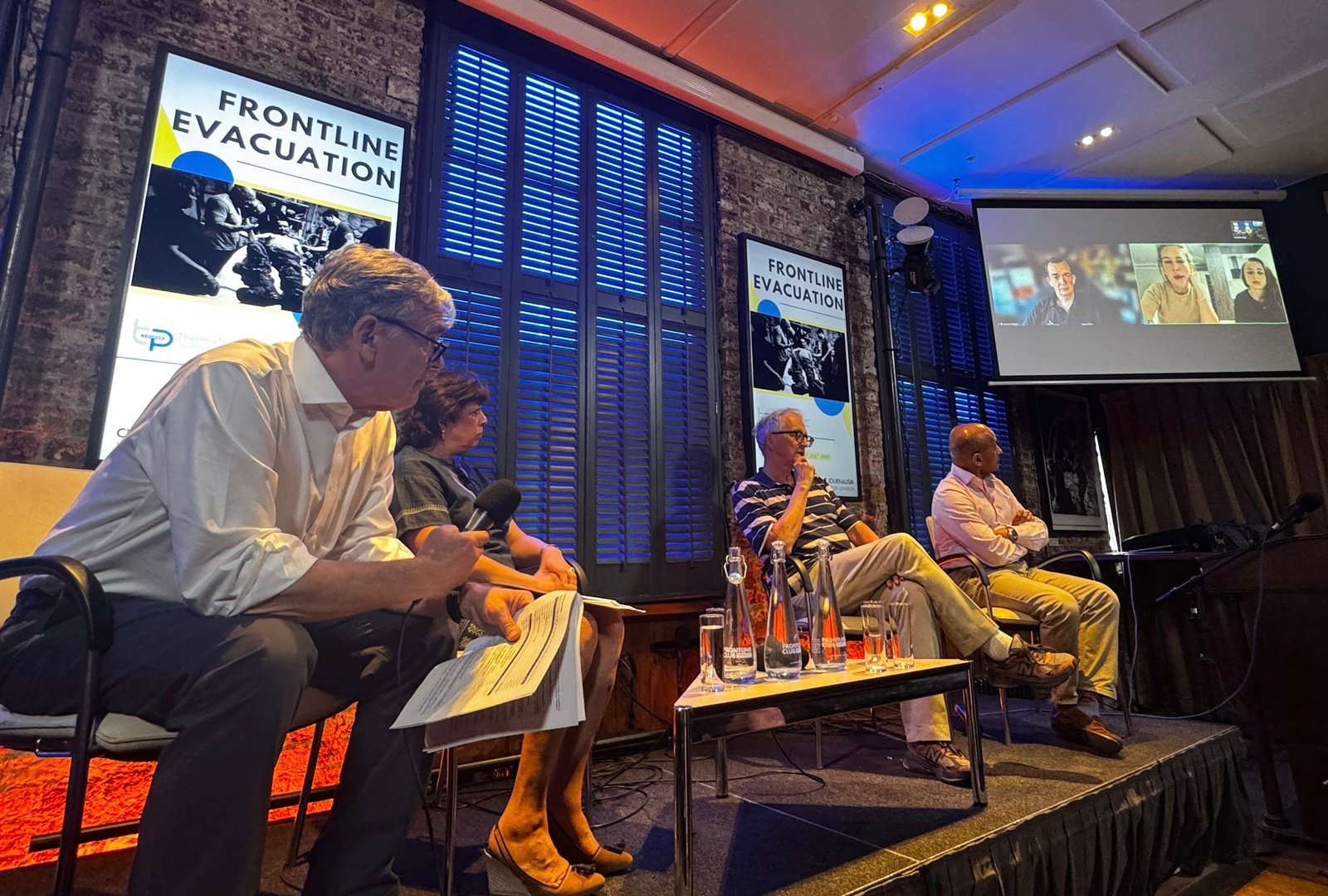
The Frontline Club is a meeting and events space in London for journalists, photographers, and those interested in international affairs. It recently hosted ‘Frontline Innovation: Medical Evacuation,’ an event by the LSN Group on the developments and challenges of medevac in Ukraine.
The event begins with a short film by Ukrainian charity Lawyers’ Move, showcasing their transformation of SUVs into medical evacuation vehicles. Through multiple iterations, their vehicles are now fitted with rebuilt interiors, power supply, patient-heating systems, night-vision cameras, and lightweight external armour to protect against targeted drone attacks.
Panellists Jeremy Mauger, from East Anglian Air Ambulance (EAAA), and Mary Anne Cordeiro, CEO of ThermoTraumaPort (TTP), then discuss their collaborative development of the TTP medevac device.
A decade ago, Mauger identified a critical gap in trauma care: too many patients were dying pre-hospital from the lethal triad of hypothermia, acidosis, and coagulopathy. The device addresses this by keeping patients warm using an integrated heating system. It’s also X-ray transparent, allowing patients to remain on it during CT imaging.
Mike Wright and Professor Shehan Hettiaratchy also join the panel. Wright brings expertise in digital transformation to highlight the challenges to innovation posed by poor data collection, whilst Hettiaratchy—a surgeon—emphasises the necessity of early intervention to prevent problems from being “amplified” as they’re passed along the treatment chain.
But this amplification of trauma complications in Ukraine is not only confined to the individual patient.
What emerges as perhaps the most significant takeaway from the event is Ukraine’s growing antibiotic resistance crisis, and the potential of severe implications for Europe.
“A huge biosecurity risk”
Hailie Uren is an antimicrobial resistance specialist and joins remotely from Kyiv, alongside surgeon Solomiia Voitsekhovska. For the past two years, Hailie has worked in a hospital just 45 miles from the Polish border. Over 90% of casualties arriving at this facility are already infected, with 40% of the war-wounded infections completely resistant to all antibiotics. This includes the “very newest antibiotics,” adds Hettiaratchy.
“It’s a huge biosecurity risk,” says Uren. “It will spread across Europe. It already is.”
She cites cases of German hospitals which have closed entire departments to do full cleans after receiving Ukrainian casualties. This is to prevent bacteria “they’ve never seen before” from spreading among civilian patients.
But in Ukraine, closing entire departments for decontamination is simply not an option. In some hospitals, the ratio of patients to nurses is 30:1, and “it’s absolutely not possible” to wash each patient daily, or to monitor every invasive line. With almost 80% of combat casualties treated in civilian hospitals, transmission becomes extremely difficult to prevent.
So, What’s the Solution?
When antibiotics don’t work, surgeons like Solomiia Voitsekhovska or Shehan Hettiaratchy are called upon. However, surgery is resource-intensive and cannot be scaled to the volume of resistant casualties that are being received.
Prevention is therefore time critical. As Uren explains, there is only a five-day window to treat contaminated wounds where infection can be prevented as “much as possible” before signs show.
But whilst rapid medical evacuations in previous conflicts such as Iraq and Afghanistan meant that contamination could often be treated within hours, drone warfare has changed this. Surveillance drones now track collection points, targeting both casualties and medics to prevent evacuation. This means that journeys to medical facilities in Ukraine can stretch across several days, dramatically narrowing the window to intervene before infection takes hold.
With these increasingly challenging evacuation timelines, medical innovation must therefore become central to frontline care. Mary Anne Cordeiro’s TTP device, for example, has been designed with infection prevention in mind, incorporating a single-use cover to minimise the risk of cross-contamination between patients.
Additionally, data collection will be vital to inform infection-related innovation in Ukraine. Mike Wright notes that medical environments in general rarely capture clinical data. This is a gap that Uren is addressing through several research projects aimed at identifying where and how bacterial resistance emerges along the evacuation pathway. The microbiomes of patients are tracked from a pre-deployment baseline, and potential pre-existing colonisation is also examined. Furthermore, an additional study will soon assess the relative effectiveness of different antiseptic approaches in preventing wound contamination.
But innovation can also come by reframing the way we think about antibiotic resistance. Uren underlines this:
“If our infections can no longer be treated with antibiotics, how different is the situation in Ukraine…[from] a biological warfare agent, like anthrax? Would we wait for the patient to become symptomatic before applying principles of preventing that infection, as we are now doing with the infected patients in Ukraine?”
Uren’s centrepiece project applies this logic in practice. A novel decontamination unit is being introduced where casualties are thoroughly cleaned using CBRN response principles. The aim is to prevent heavy contamination and colonisation entering the hospital system. All patient clinical data will be collected, to ensure the project is effective. Additionally, evidence-based self-care practices will be taught to the casualties. If the patients are able to wipe and clean themselves effectively, then this will release some of the burden on the already overstretched nurses.
New challenges Create New Breakthroughs
“Every war leads to new infections, new challenges,” says Nicholas Mellor, director of the LSN Group and moderator of the evening’s discussion. “But [war] also leads to new breakthroughs in care that leave a legacy forever around the world.”
Throughout human history, infection has been one of war’s deadliest consequences. The advent of antibiotics has, of course, been revolutionary, but the resistant bacteria we are seeing in Ukraine now require new innovation. Prevention—through improved decontamination, smart data collection, and novel frontline devices—appears to be key.
With the potential wider implications for public health, the stakes are high; whilst combat may not penetrate Europe’s borders, a biosecurity crisis could.
But the medical breakthroughs from Ukraine will cross those same borders. And they may well leave a lasting impact on how the world confronts antibiotic resistance.