Meet the Californians joining one of Christianity’s oldest churches.
Orthodox Christianity is booming in the West. Conversion stories are everywhere, with Religion Unplugged reporting that many Orthodox congregations in the US have “doubled or tripled in size” since the pandemic.
But most of this attention has focused on the largest Orthodox tradition: Eastern Orthodoxy. Far less discussed is Oriental Orthodoxy, and whether it is experiencing anything similar.
The Coptic Church is one of the best-known branches of the Oriental Orthodox tradition. It is also among the oldest Christian churches in the world, with origins traditionally traced to Alexandria, Egypt, in the mid-first century.
Literally, the word “Coptic” means Egyptian and the church preserves the ancient Egyptian Coptic language as part of its liturgy. So, could a church so historically and culturally rooted in Egypt also be part of Orthodoxy’s boom in the West?
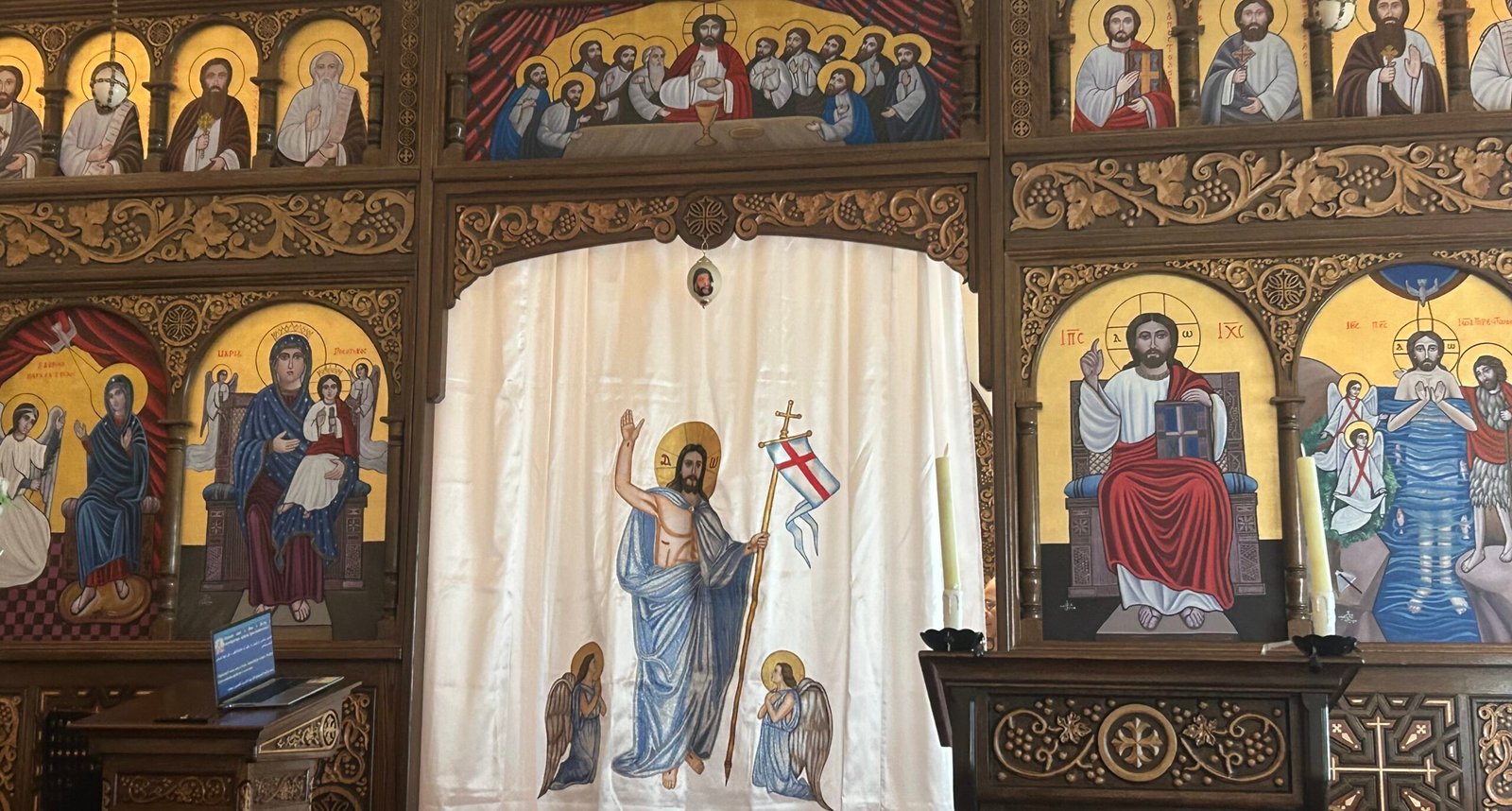
I set out to answer this question, attending the Coptic Orthodox Church of Saint Mary and Pope Kyrillos in the Netherlands, for a Wednesday morning Divine Liturgy. The service lasts 2.5 hours and is conducted mainly in Coptic and Arabic. Men and women sit separately, and women cover their heads. Incense fills the room and icons line the walls, whilst hymns are often accompanied by the soft rhythm of cymbals or a triangle.
At the end of the service, I approach a man sitting in front of me and ask if there are any converts in the congregation.
“Me,” he replies.
This comes as a surprise as I’d seen him speaking Arabic, but he explains that he’s Lebanese, raised as a Maronite Christian, and is in the process of being chrismated into the Coptic Church. He then tells me that a number of Dutch converts also attend, however, this is usually for the Sunday liturgies.
The conversation confirms that there are indeed converts to the Coptic Church, so I take to Reddit to look for others. I receive a number of responses and am able to arrange three interviews: two with converts and one with a Coptic priest.
All three turn out to be based in California, which gives my story an unexpected focus: California’s Coptic Converts…
“I Was Really Trying to Find God”
Gethzemany, 27, lives in southern California. She grew up as a Jehovah’s Witness, though she says the religion never fully made sense to her and started to question everything. After she and her family stopped attending meetings, Gethzemany entered what she describes as a “religious crisis.”
She tried to get back into being a Jehovah’s Witness during university but explains that “it didn’t sit right.” She also spent time enquiring into Islam and various other Christian traditions, yet none convinced her.
Then one day, Gethzemany went to her university’s Middle Eastern student centre, where she met some Coptic Orthodox Christians. “I was really trying to find God,” she tells me, “so I started going to the Coptic club meetings.” And it was there, during Lent, that she says she felt God reveal himself through an archdeacon. “The way he was talking was so loving… I was like, maybe this is it…”
So Gethzemany went to speak to a priest at a local Coptic church. Totally unexpectedly, she says the words just came out of her: “I want to convert!” And after a six-month catechism process, she was baptised into the Coptic Church in August 2020.
The Numbers Are Growing
Father Michael Maximous, born in Egypt, was ordained as a priest at St. Basil American Coptic Orthodox Church in San Diego in 2019. He runs online catechism classes for those preparing for baptism.
Around the time Gethzemany was baptised, not many people were converting to the Coptic Church. Father Michael only baptised one adult in his first year at St Basil. This rose to eight in 2020, nine in 2021, ten in 2023, and fourteen in 2024. But in 2025, thirty-five adults who had attended his catechism classes were baptised into the Coptic Church, marking a large increase. At the time of speaking to Father Michael in April, nineteen adults have already been baptised in 2026. So what is the reason for this rise?
“An online presence is definitely having an impact,” Father Michael tells me. He explains that through online comparative theology content, many become interested in the Coptic Church. “People are looking for an authentic church with apostolic origins, that is biblical in nature, and that’s stood the test of time” he says. “They see how the Coptic Church is on firm ground, so they enquire more themselves.”
I ask Father Michael whether there is active outreach by his church to bring people to the Coptic tradition. “Not in the way you may expect,” he replies, “we don’t have someone on the corner of the street preaching.” He elaborates that evangelising takes place through the witness of the members of the church and the way that they take their faith seriously. Or through social services that his church involves itself with, such as feeding the hungry. This is what has an impact on people and brings them to look into Coptic Orthodoxy, he explains.
“I Wanted to Know That Kind of Love”
It was this seriousness towards faith that attracted Ryan, 25, to the Coptic Church. “Something that really drew me to the Coptic Church was the stories of the martyrs… the history of the martyrs that the Coptic Church has,” he says. Ryan references the 21 Coptic Martyrs of Libya, who were killed by ISIS in 2015 after refusing to give up their faith.
“We read about the saints of the past, but we never really consider there are martyrs of our age,” he adds. “Seeing the love that they [the 21 martyrs] had, I wanted to know that kind of love.”
Ryan is from Riverside, California, and comes from a Mexican Catholic family. After leaving Catholicism, he first became an atheist before eventually joining a Pentecostal church, which he later left after an argument with the pastor over the church’s doctrines. He visited churches from various other denominations, but says the Coptic Church is where he found the most peace. “Before going to church, I can have a thousand thoughts in my head,” he says, “but the moment I step into that church, I have zero worries.”
Throughout my conversation with Ryan, he repeatedly mentions that the Coptic Church “hasn’t changed.” He emphasises how consistency in doctrine, foundational teachings, and forms of worship throughout almost 2,000 years of history was instrumental in his decision to be chrismated into the Coptic faith.
I find out that Ryan prepared for his chrismation by partaking in Father Michael’s online catechism classes. I’m curious to observe these, so join for week four: The Three Ecumenical Councils and Monasticism. The class lasts an hour and reminds me somewhat of a university lecture, but with more engagement from those in attendance. Father Michael teaches prospective converts about key events in church history, such as The First Council of Nicaea (325 AD), as well the origins of Christian monasticism which was founded by Anthony the Great, an Egyptian saint.
There are 25 people in Father Michael’s catechism class and, whilst the majority appear to be young adults, the class is diverse. I observe black, white, and Hispanic attendees, and people attend both as individuals and in couples.
Since the classes take place online, prospective converts are not required to live in California; in fact, people living as far away as Uganda have attended Father Michael’s classes. However, his church falls under the Coptic Diocese of Los Angeles, Southern California, and Hawaii, which is the largest in the US. Of course, this is mostly due to the high Egyptian population, but the growing number of converts is prevalent in churches such as St Basil. In fact, Father Michael tells me that St Basil is trending towards a 50-50 ratio of Egyptians to non-Egyptians in its congregation.
Integration Into the Church
St Basil is especially accommodating to converts because it conducts its services in English. But this is not the case at Ryan’s church, which is smaller and conducts its services in Arabic. I ask him what the integration process has been like, and he tells me he has been warmly received by the Egyptian members of the congregation. Some are even helping him to learn Arabic, he explains.
For Gethzemany, integration has been a natural process. Whilst her father is Mexican, her mother is French-Algerian, meaning Middle Eastern culture was already familiar to her. “Maybe I’ll get questions like: are you Egyptian,” she says, “but I don’t feel like an outsider.”
Beyond integration alone, Father Michael emphasises that converts have become an integral part of the congregation at his church. He notes that many have made significant sacrifices in joining the Coptic Church, sometimes leaving behind friendships or disapproving family members, which often makes them especially dedicated in their faith. It is frequently the converts who arrive earliest to liturgies, he tells me, calling them “the best of examples.”
This devotion is reflected in Ryan’s practice. In the eleven months since he began attending his church, he has only missed one liturgy. Moreover, he tries to have an impact on young people in the congregation, so that they stay committed and don’t take their faith for granted. “As a convert, I want to bring that same fire that I have for the Church to people who were born and raised in it,” Ryan says.
New Faces in the Pews
Gethzemany and Ryan are just two examples of Californians who have converted to the Coptic Church. And their accounts, along with Father Michael’s, suggest that this number is growing.
“When I was converting, my Coptic friends were like: I’ve never seen an adult baptism before,” says Gethzemany. “I feel like there’s a convert every week now!”
Whilst the continuity of doctrine and liturgical tradition was emphasised as a key factor in both Gethzemany and Ryan’s conversions, something does now appear to be changing in California’s Coptic churches.
Not the teachings. Nor the traditions. But the people who are filling the pews.