
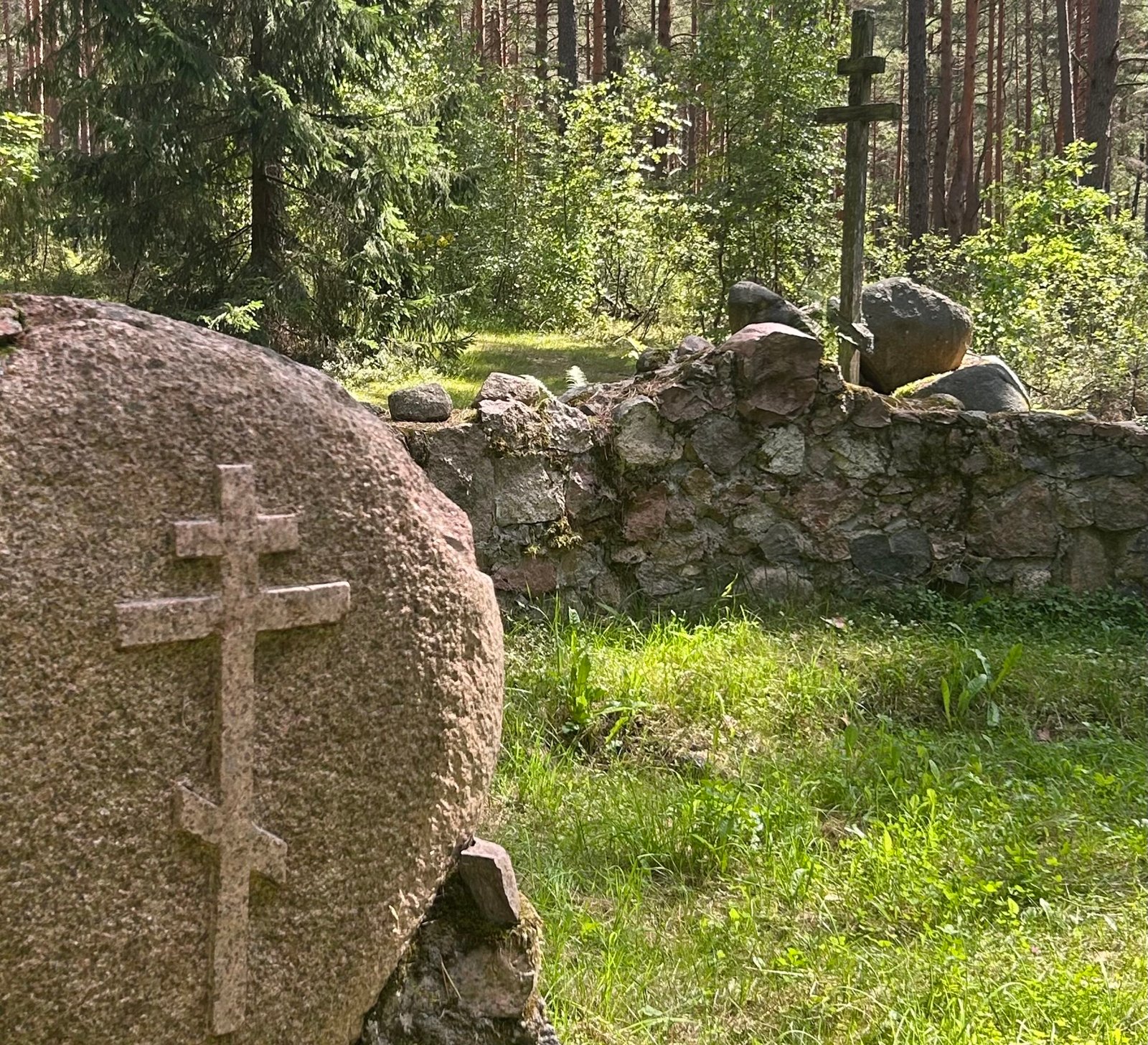
The woods of eastern Poland hide the ruins of an unfinished temple that was meant to become the new centre of the world. All that remains are brick foundations, now engraved with the symbols of the major monotheistic religions.
Last month, I found myself staying in a guesthouse just a few kilometres from the Belarussian border. This remote part of Poland is not the most touristic, especially for foreigners, so the guesthouse host asked what had brought me to the region. My girlfriend stepped in, sparing me from an awkward attempt to answer in my very limited Polish!
“We’ve spent the last few days conducting interviews,” she explained, “he’s here researching for an article.” She then got into a longer conversation with the host, before turning to me and asking if I’d heard of “Wierszalin.” Admittedly, I had not. Yet after an evening of research, I became intrigued by the little known story behind this “Wierszalin” place.
The next morning I was there. Standing deep in the woods in what had once been imagined as the world’s “New Jerusalem.”
The Making of a “Prophet”
The story of Wierszalin centres around a man of Belarusian origin, named Eliasz Klimowicz. Eliasz was born on 2nd August 1864, in a village called Grzybowszczyzna which is now in eastern Poland, but was then part of the Russian Empire. His birth fell on the same day that the Feast of Saint Elijah is celebrated in the Eastern Orthodox tradition — a coincidence that would later prove to be rather significant.
Eliasz was illiterate and spent his early years working on a farm. His life was ordinary and quite unremarkable. However, this would all change around the turn of the 20th century when he began to have dreams in which he was commanded to build a church. In search of an explanation for these dreams, he made a pilgrimage of over 1000km to an Orthodox archpriest. And he returned with an answer: the dreams were a message from God, and he must do as God wills.
Now around the time that Eliasz was having his dreams, something else was happening in Grzybowszczyzna. A bandit was running riot in the village, stealing from farms and instilling fear into the locals. But it just so happened that when Eliasz was on his pilgrimage, the bandit died. The only explanation for this, many locals thought, was that it was a miracle. Eliasz’s pilgrimage had saved the village!
Soon enough, church construction began, with Eliasz selling his possessions, land, and gathering donations to fund the project. However, when the First World War arrived, operations had to be temporarily abandoned.
Eliasz was also forced to leave his village in 1915, to head deep into Russia. This was due to what’s known as the Bieżeństwo, where masses of Orthodox civilians from the western borderlands of the Russian Empire were evacuated eastward.
It was not until 1919 that Eliasz would return home, but he did so as a changed man. He had witnessed a different Russia from the one he’d experienced during his visit to the archpriest a decade earlier. The extreme violence of the Russian Revolution had scarred him, leaving him convinced that the end of the world was approaching. Eliasz therefore needed to do something to help people survive this impending global apocalypse…
The Rise and Fall of Wierszalin
His sermons increasingly centred on the coming apocalypse, and he began making predictions about the future. Coupled with his supposed miracles, this led his followers to believe he was a prophet. And given his aforementioned date of birth and his name, it logically followed that Eliasz Klimowicz was really the Prophet Elijah; sent to the people of Stara Grzybowszczyzna to prepare them for end times!
Naturally, Eliasz was declared a heretic by the Orthodox Church. Yet the condemnation did not diminish his influence. Many of his followers remained loyal, and the group established their own traditions. One of his most dedicated followers, Paweł Bielski, wrote a hymn book about Eliasz. Another, Józef Miron, would ride around on a white horse blowing a trumpet, declaring that end times were coming.
But Eliasz had a solution that offered salvation.
The group would build Wierszalin: a utopia in the middle of the woods that even Satan would be unable to enter. When everything else had been destroyed in the apocalypse, Wierszalin would become the centre of the new world. It would be the “New Jerusalem.”
Even the name Wierszalin itself reflected the group’s beliefs. It is derived from the Slavonic word sovershilos, meaning “it is finished” or “it is accomplished,” a direct reference to Christ’s final moments on the cross:
“When he had received the drink, Jesus said, ‘It is finished.’ With that, he bowed his head and gave up his spirit” (John 19:30, NIV).
By adopting this name, the group framed Wierszalin (and Eliasz) as the fulfillment of God’s plan. And for some followers, this theological climax meant Eliasz was not just a prophet, but the second coming of Jesus Christ!
Construction of the sanctuary moved forward and a couple of hundred believers ended up moving to Wierszalin. A handful of the most devout assumed biblical roles; for example, the aforementioned Paweł Bielski declared himself as Apostle Paul. Some followers had even sold all that they owned, comforted by the conviction that they would not need these possessions in the new world.
But the apocalypse never came, and with each new sunrise Eliasz’s followers grew increasingly impatient with his unfulfilled prophecies. Maybe Eliasz was not who they’d thought him to be? Maybe no impending apocalypse was coming?
One well-known story describes how a group of followers intended to crucify Eliasz, convinced that his sacrifice would be necessary to trigger end times. When he refused, his followers were left with even more doubts. Whether this particular event was an actual historical occurrence or legend remains unknown, but it does symbolise a growing desperation among a group of people who had given up almost everything for an unfulfilled prophecy.
What also remains unknown is what ended up happening to Eliasz himself.
He disappeared in 1939, not long after the outbreak of World War Two, but to where is unconfirmed. Some believe he was killed by the Red Army during the Soviet invasion of Poland, whilst others believe he was sent to a gulag.
With their leader gone, Eliasz’s followers soon departed as well, and Wierszalin was left uninhabited. All that remained were a few wooden huts and the stone foundations of Wierszalin’s temple, left forever unfinished…
The Ruins of a Forgotten Utopia
On my own visit to Wierszalin’s unfinished temple last month, I was struck by its remoteness. As we made our way from our guesthouse, the roads became narrow, and the tarmac became gravel. After parking the car, a 15 minute walk into the woods followed. There was no one there but us. It was a little eerie.
The first thing I saw of the ruins was the Orthodox cross, and then small grey stones forming a circle where the supposed most important temple on the planet was meant to stand.
Some of the stones had engravings: the Islamic crescent, a Jewish menorah, and Protestant, Orthodox, and Catholic crosses. These were done by the local forestry authority in 2008, which decided to reinvent the site into what is now known as the “Monotheistic Temple of the World,” inspired by Eliasz’s vision that Wierszalin would become the “New Jerusalem.”
Also notable was the large stone in the centre of the ruins that had a number of coins left on top. I couldn’t confirm the reason these coins were left, but presume they may have been some kind of offering. After all, Eliasz’s movement was holding church services as late as the 1970s, with some followers believing he would still return to Wierszalin to fulfil his prophecy. Even today, people gather in Stara Grzybowszczyzna on the feast day of Saint Elijah, to remember Eliasz and his followers.
As I leave Wierszalin, I find myself wondering what really motivated Eliasz to do what he did. Was he just simply a con man who was hungry for power? The story — if true — of his refusal to allow his followers to crucify him might suggest that, at some point, he realised things had been taken too far. Maybe he didn’t have as much conviction in his beliefs as his followers had thought?
But doing everything he did in his life due to a mere thirst for power also appears to be an oversimplification. Accounts suggest he had little interest in money, for example, and gave away much of what he’d received from others.
Perhaps Eliasz genuinely believed that he was doing what God had commanded him to do? Perhaps he was undergoing some sort of religious psychosis? Perhaps his beliefs evolved as his following grew, until the peasant who had simply dreamt of building a church had suddenly become a miracle worker, a prophet, a messiah, and the founder of the new centre of the world.
There is no real way to know any of these things for certain now, and that uncertainty is part of what makes Wierszalin so strange. Almost a century later, the apocalypse never came, the “New Jerusalem” was never built, and Eliasz disappeared. But the traces of this abandoned utopia are still here, left half-hidden between the trees.