
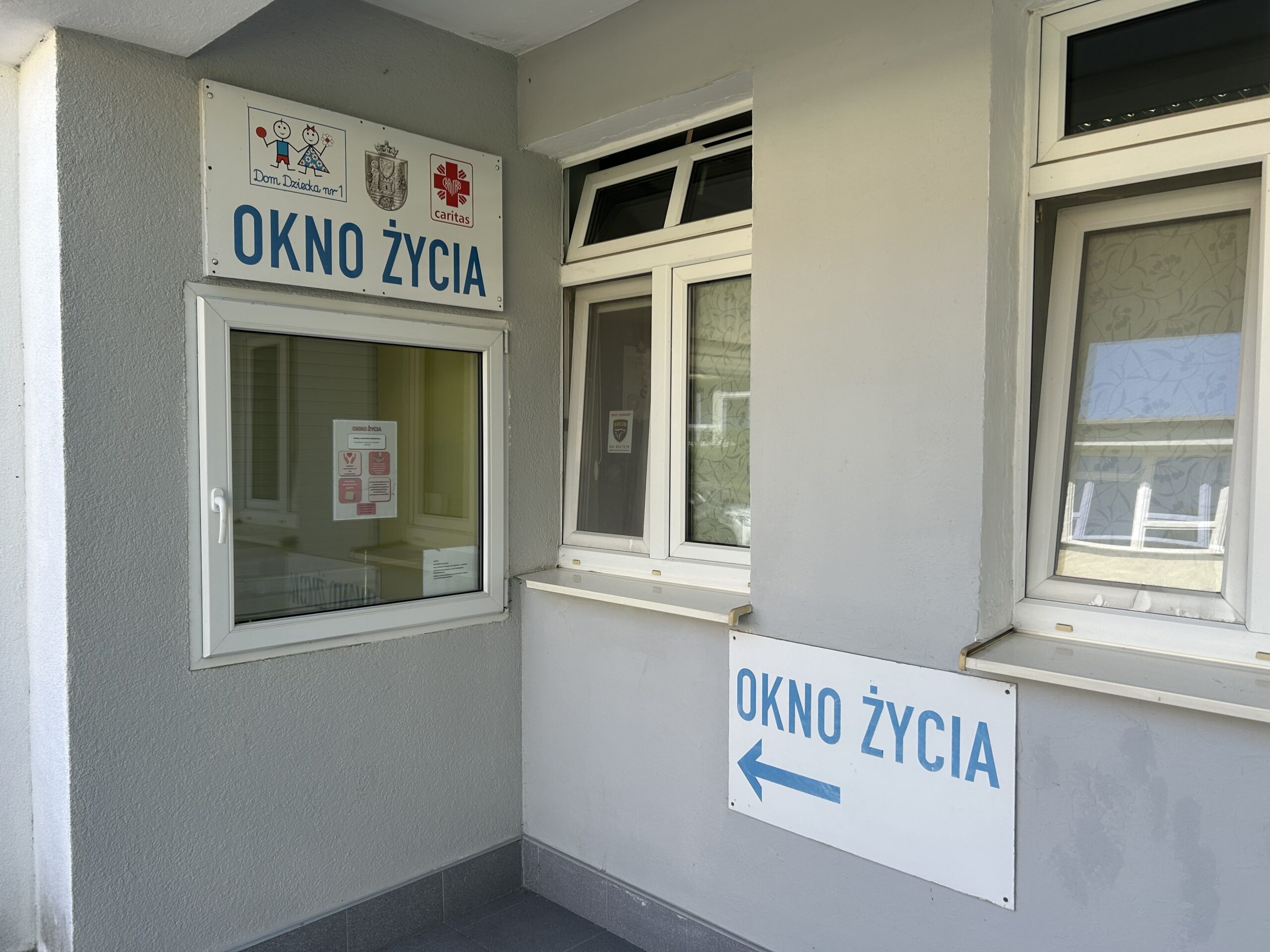
“Nothing prepares you for the emotions that overcome you when the alarm rings… no matter how many times you’ve done it,” Bożena Tórz, Swoboda Family Support Centre.
Over the past 20 years, several small hatches have appeared on the sides of various buildings across Poland, with the words OKNO ŻYCIA (Window of Life) written above them. Left unlocked, the purpose of these hatches is to offer mothers who wish to surrender their children a safe, legal, and anonymous way to do so.
But the initiative has also faced controversy, most notably from the UN, who have argued that Window of Life initiatives do not comply with Article 8.1 of the Convention on the Rights of the Child, which recognises: “the right of the child to preserve his or her identity, including nationality, name and family relations as recognised by law without unlawful interference.” By allowing mothers to surrender children anonymously, such critics argue that Window of Life initiatives may undermine these rights, as the majority of these children will never know their parents’ identities.
Despite this backlash, more than 60 Window of Life hatches operate across Poland today. Whilst the vast majority are operated by church institutions, a handful are run by secular organisations.
One of these secular institutions is the Swoboda Family Support Centre in Poznań, a municipal institution operating under the Ministry of Health. It is located in a building with a long history of providing support for families. Since the 1950s, the building has been used for maternal and child welfare services, including offering a safe residence for women in late-stage pregnancy and for teenage mothers. It has also functioned as a nursery and an orphanage, and today houses the Swoboda Centre, which provides a range of family-related services, including the coordination of foster care placements for children in its care. The Window of Life initiative was introduced at Swoboda on 25 March, 2009. Since then, someone has always been available in the building, ready to respond the moment that the window’s alarm system sounds.
Intrigued about the people behind Swoboda’s Window of Life, I arranged an interview with the organisation’s director, Agnieszka Ugorek-Macka. I met Agnieszka at the centre, along with Natalia Jeżewska, coordinator of several Swoboda initiatives, and Bożena Tórz, one of Swoboda’s longest-serving employees.
When the Alarm Sounds
Bożena has worked at the centre for 35 years and is often on-call to respond to the Window of Life alarm, which sounds when the window is opened. “Each time the alarm rings, even though we know the procedures, all the emotions come flooding,” she tells me. “Nothing prepares you for the emotions that overcome you when that alarm rings… no matter how many times you’ve done it.”
When the alarm goes off, it is silent in the hatch itself but sounds loudly throughout the rest of the building to alert staff like Bożena. However, the system is also prone to false alarms caused by pranks or accidental triggers by passers-by. Agnieszka describes people leaving empty beer bottles in the window, children playing with the latch, and even one instance where a man placed his girlfriend inside for a photo. “The worst is when this happens at night, because the alarm wakes up the children [living at Swoboda],” says Agnieszka. The alarm can cause distress for these children, especially given the fact that a number come from Ukraine, and may associate sudden, loud alarm sounds with traumatic experiences.
Despite the occurrence of these false alarms, the windows are also, of course, used for their intended purpose. And when Bożena or other staff members arrive to find an infant has been abandoned, the process is similar each time: “first we take the infant and place them into a heated cot… we then inform the director, call the police, and call the ambulance so that the baby can be taken to the hospital,” Bożena explains. Whilst some of the infants left at Swoboda are a couple of months old or more, many are newborns with umbilical cords still attached, having been born at home just a few hours earlier. Agnieszka also tells me that sometimes traces of substances are found in their blood, which underlines the importance of prompt medical attention.
Alongside the ambulance, calling the police is a requirement in the procedure; however, Agnieszka describes how the police’s approach has changed in recent years: “Previously, police would not investigate any of this, but now they try to investigate to make sure the mother is safe, or to see if they were made to give the child away. It’s not to punish her because it’s not a punishable offence… However, when they try to find the mother, this goes against the whole mission of the Window of Life, which is that it is anonymous.”
“It gives these babies a chance”
I ask about the anonymity issue and some of the criticism that Window of Life initiatives have received. Aside from just vocal condemnation, the UN even raised the issue with the European Parliament back in 2012, pushing for a Europe-wide ban on the hatches. However, their efforts were unsuccessful, with 11 EU countries currently operating a Window of Life system.
“Opinions are divided, and many people criticise it, but the Window of Life is a great alternative,” Natalia Jeżewska tells me: “it gives these babies a chance… the moment they are left in a window, there are multiple people who take care of the child.”
Agnieszka also elaborates, arguing that whilst women could give unwanted children away at the hospital, this is, of course, all tracked via a registry, which may deter them. Many women may not want their families to know they have given birth, and, in some cases, societal circumstances may even make it unsafe for them if their relatives were to find out. “The whole mission of Window of Life initiatives is to prevent mothers from leaving their children in dangerous places,” says Agnieszka.
“Some women may not want to give up their children at the hospital, and it’s obviously far better for them to end up at a Window of Life than to be left in the street.”
Ultimately, whilst the UN Convention on the Rights of the Child does highlight that children have the right to an identity and family relations, it also recognises “that every child has the inherent right to life” (Article 6.1) and calls for states parties to “ensure to the maximum extent possible the survival and development of the child” (Article 6.2). In the circumstances faced by mothers who resort to baby hatches, proponents may argue that the existence of such hatches as a last resort gives these babies the opportunity to exercise their right to life, survival, and development.
Agnieszka also highlights that criticisms of Window of Life initiatives may stem from other issues. In Poland specifically, she also adds that unfavourability towards Window of Life initiatives may be religiously based: “Poland is divided… We are a Catholic country, but there are a lot of young people today who have a negative attitude towards the Church, and some people believe Window of Life hatches are a Catholic institution.” Whilst it is true that the majority of hatches in Poland are associated with the Catholic Church, the initiative itself is not inherently religious and functions as a humanitarian safeguard that remains defensible from a purely secular standpoint too.
The Certainty of Care
As a family support centre, Swoboda’s role extends beyond immediate care for the children left at the Window of Life. “All the kids at Swoboda are waiting to be placed in foster care and ultimately adopted,” Natalia tells me.
But what if the mother comes back for her child? “If she decides she wants to, everything is done through a court,” says Bożena. “Even if she returns after just a few hours, she cannot do so without going through legal channels,” adds Agnieszka. “Child support services investigate whether she’s mentally stable to be a mother and what prompted her to leave the child… If she’s in crisis, they try to help her through it.” Arrangements may involve foster families who maintain contact with the biological parents, which is something child support services and Swoboda can help facilitate.
Sitting in Swoboda, I was able to access a human perspective on an issue often discussed purely in legal terms. What drives Agnieszka, Bożena, and Natalia in their work is clearly a desire to help the most vulnerable in society who may otherwise be left with no help. “We are women, we are mothers, so it’s always difficult and touching,” Agnieszka tells me. “We feel for the baby and for the mother too.”
Poland’s windows of life remain controversial. But when the alarm rings, what matters in that moment is that there is a child who needs care. Nothing can fully prepare these women for that moment, only the certainty that when it comes, they will be there.
An extremely powerful article confronting a seemingly divisive issue – balanced and very well written.